Welcome to Palermo, Sicily To the first-time visitor, Palermo is a city of ever-changing character. An abundance of dusty museums, Arabian domes and flourishes of baroque splendor jostle with boisterous markets, chaotic traffic and oppressive summer heat. It’s also a […]
Welcome to Palermo, Sicily
To the first-time visitor, Palermo is a city of ever-changing character. An abundance of dusty museums, Arabian domes and flourishes of baroque splendor jostle with boisterous markets, chaotic traffic and oppressive summer heat. It’s also a charming city where the air smells of sweet pastries, backstreets open onto pretty squares and mosaiced churches dot all over.
You can’t escape history in Palermo. The city’s awash with Arabic cupolas, baroque facades, byzantine mosaics and Norman relics. But now there’s also a contemporary art scene, Palermo’s food is cutting edge and there are plenty of great new places to stay.
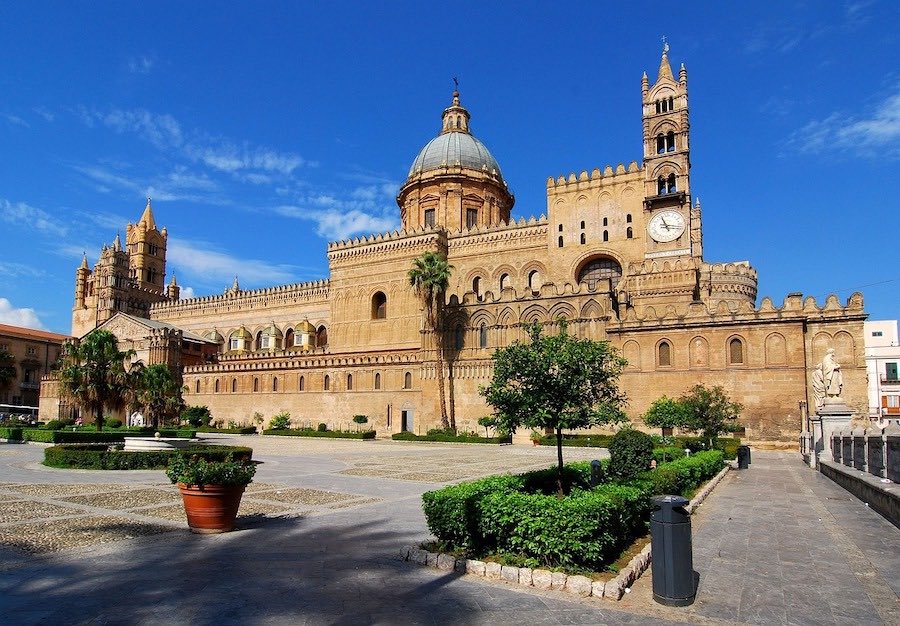
Cathedral
The east exterior of Palermo’s cathedral has the original Norman character: three apses, cross-over round arches, and curved parapets. The south side, overlooking the square, is known for its 1453 Gothic-Catalan portico through which one enters. One of its columns, with an early Arabic inscription, comes from a mosque. The triangular pediment contains an engraving, God the Father on His Throne, and above the doorway, a 13th-century mosaic of the Virgin Mary on a gold background. The bell-tower goes back to the 12th century but was rebuilt in 1840.
You enters into the right aisle, where the first two chapels contain the monumental tombs of the Norman-Hohenstaufen dynasty. The four sarcophagi are in purple Egyptian porphyry, previously permitted only for the tombs of Roman and Byzantine emperors. At the left front is that of Frederick II, supported by four lions; the tympanum shows the Norman crown, and on the top are decorative panels of the Virgin Mary and Christ between symbols of the Apostles.
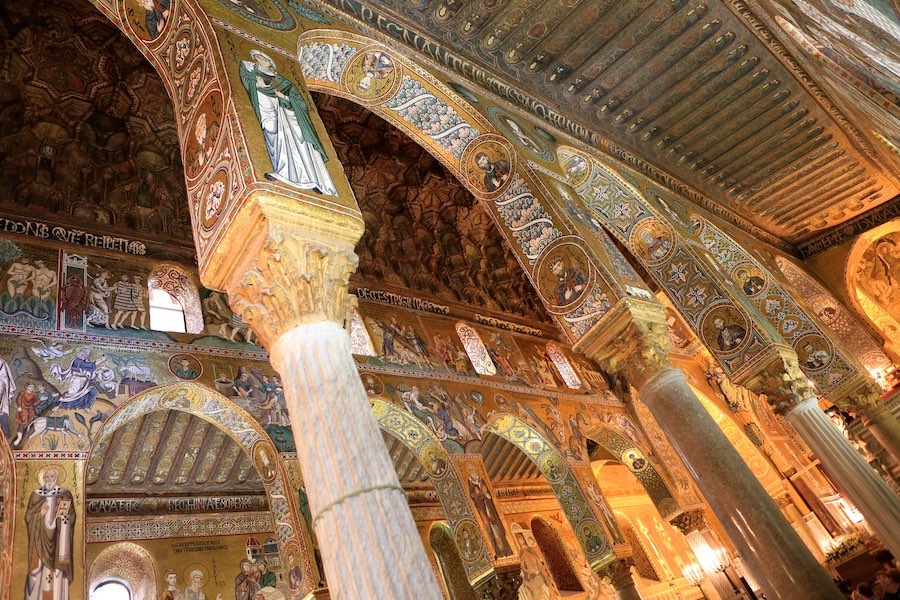
Cappella Palatina
This court church of the Normans was consecrated in 1140; the mosaics in the chancel were probably completed three years later, and those in the nave somewhat later. Around 1350, the mosaic on the west wall portraying Christ between Peter and Paul was created
In spite of all the changes through the centuries, the interior has not lost the overall harmony between the Latin basilica, the Byzantine dome and mosaic decoration, and the Arabic stalactite ceiling. There is a mystical half-darkness in this three-aisled basilica, pierced only by a shimmer of gold. The wooden ceiling of the central aisle is decorated in the Arabic style, with stalactites painted with small scenes.
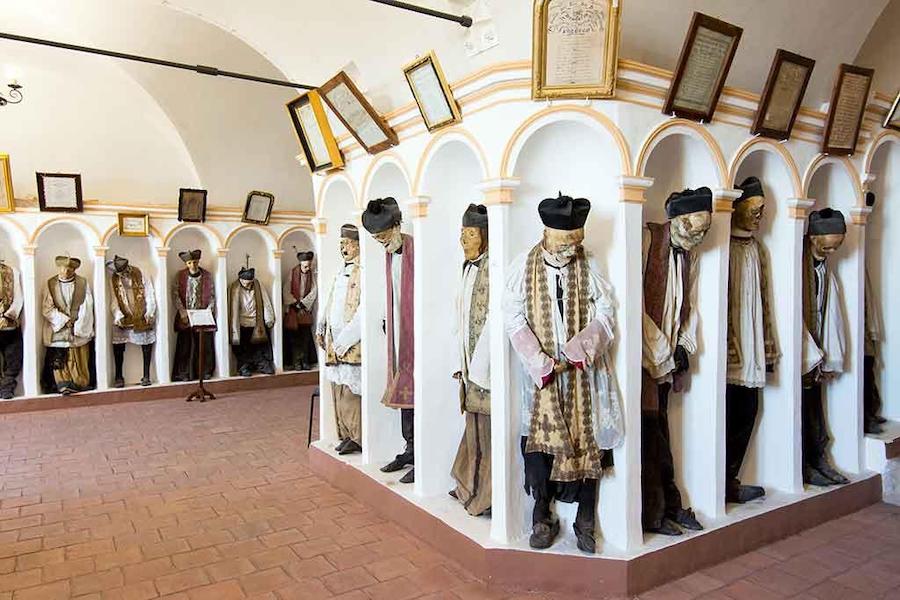
Catacombe dei Cappuccini (Capuchin Catacombs)
By far Palermo’s most bizarre attraction, however one of its most popular, is the Capuchin Abbey, known for its Catacombs. These underground passages were chiseled in the volcanic rock after 1599 and used as burial places right up to 1881. Inside, one will be greeted by the macabre scene of about 8,000 mummified corpses, arranged by sex and status, lying in the passageways or hanging from the walls.
The clothes they wear may look newer, as until a few years ago the mummies clothes were changed regularly by their relatives. The bodies were first laid in the colatoio, a small, tightly closed drying-room, and after eight months, they were washed in vinegar, dressed, and placed in the niches in the walls or in open coffins.
Palazzo dei Normanni (Norman Palace)
In the 9th century, the Arabs built a palace for their Emir, and under the Norman rulers and the Hohenstaufen Frederick II, the palace became even more splendid. It suffered a long period of neglect, until the Spanish viceroy renovated and extended it to use as his residence. Since 1947, the regional parliament of Sicily has sat here.
You enter into the Cortile Maqueda, a square courtyard that was constructed in 1600 surrounded by three stories of arcades with rounded arches. Steps lead to the core of the palace, the Cappella Palatina on the first floor and the Royal Apartments on the second. Here, you’ll see the Hall of Hercules, where the Sicilian Parliament now sits, just as the Barons’ Parliament did in the Middle Ages.